AI Interviewer: What to Expect and How to Prepare
An AI-conducted interview is a format problem, not a mystery. What the screening captures, how to pace a 60–90 second answer, and a one-week practice routine.
An AI interviewer is usually a delivery and scoring layer, not a conversational adversary. If you are wondering what to expect from an AI interviewer, start here: in most screenings the questions are fixed or lightly branched, your answers are recorded or typed, and a person often reviews the output afterwards. So the preparation is not about outsmarting a machine. It is about giving the same honest answers you would give a human, with deliberate pacing, clear structure and a camera framing that lets the reviewer see and hear you properly. This guide covers what the format captures, how to pace an answer when nobody nods back, and a short practice routine you can run out loud before the real thing.
What an AI interviewer actually is (and what it is not)
Three formats get called an "AI interview", and they ask different things of you.
- A recorded video screening. Questions appear one at a time, you get a short window to think, then you answer to camera. There is no one on the other end.
- A text-based chat screening. You type answers to scripted questions, sometimes with a time limit. Structure and relevance matter more than delivery here.
- A live interview with a human, where AI takes notes or suggests follow-ups. The conversation is normal; the software sits in the background.
The preparation overlaps across all three, but the mechanics differ. In a recorded screen, camera and pacing carry weight. In a chat screen, written clarity does. In a live interview, it is still a human conversation and you should treat it that way.
What the bot is not: it is rarely improvising clever follow-ups or judging your personality in real time. Questions are usually fixed or lightly branched, and a human often reviews the recording or transcript. That is good news. It means you are preparing for a predictable format, not a mystery opponent.
One honest limit. Nobody outside a given employer can tell you what that employer's system scores. So prepare for the behaviours any structured screening rewards: answers that fit the question, concrete examples, and steady delivery. Those hold up whether a person, a tool, or both are watching.
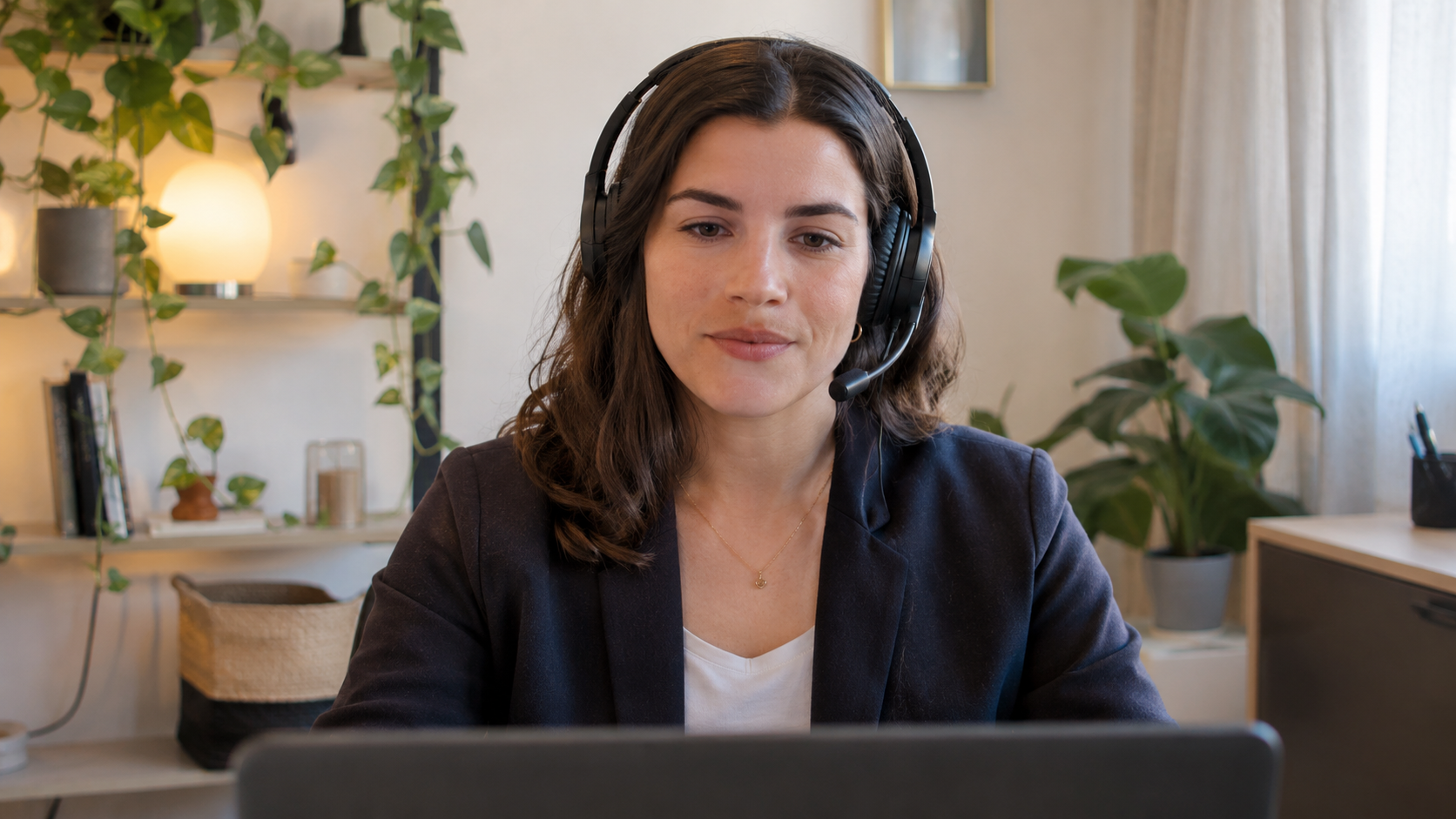
What an AI interviewer is likely to score, and what it can't
Automated screening tends to look at things that can be checked consistently:
- Relevance. Did the answer address the question that was asked?
- Structure. Was there a clear point, an example and a result, or a wandering story?
- Concrete examples. Did you name a situation, your action and an outcome?
- Delivery. Speech pace, long pauses, filler words.
- On-camera basics. Framing, lighting, whether you appear to be looking at the camera.
What these tools are poor at is everything subtle: humour, irony, warmth, a dry aside, cultural context, the difference between nerves and disinterest. Do not try to perform for the machine. A joke that lands with a person can read as an irrelevant tangent to a scoring layer, and you will have spent your energy on the wrong thing.
The practical takeaway: because relevance and structure are checkable, spend your preparation on a small set of real stories rather than on guessing the algorithm. Five strong examples, told well, will cover most of what a structured screen asks.
Before the interview: a 20-minute setup checklist
Run this about twenty minutes before you start, not two.
- Camera at eye level. Prop the laptop so the lens sits level with your eyes. Looking down at a screen reads as slouching; looking up reads as distant.
- Light in front of you. Face a window or a lamp. Light behind you turns you into a silhouette.
- Plain background. A wall, a door, a tidy shelf. Movement behind you pulls attention away from your answer.
- Phone silenced and out of reach. A buzz mid-answer is a distraction you cannot edit out.
- Microphone tested. Record ten seconds and play it back. If you sound far away, move closer rather than turning the volume up.
- Notes within reach. Your own real examples as bullet points, not scripted answers. More on why below.
- Water and a stable connection. Both are boring and both save interviews.
On the notes: reading a script is a bad trade. It flattens your delivery into a recital, your eyes drift to the page, and it can look like exactly what it is. Bullet points with the facts of your own stories keep you accurate without turning you into a reader. If talking from points feels loose, the guide on how to sound natural with talking points in a job interview walks through the mechanics.
How to pace an answer when no one nods back
Without a human reacting, candidates tend to do one of two things: rush to fill the silence, or ramble because nothing signals them to stop. Both hurt, because the reviewer has to work to find your point.
Aim for a shape rather than a length. A short direct answer, one example, a one-line close. In practice that lands around 60 to 90 seconds. Here is a script you can say aloud:
"The short answer is X. For example, at [role] I faced [situation], so I did [action], and the result was [outcome]. That's why I'd approach this here the same way: [the first thing you would check or do in this role]."
Three cues make it work:
- Pause after the question. Take one breath before you start. It reads as composure, not hesitation.
- Lead with the answer. Put the conclusion in the first sentence, then support it. Reviewers score the front of an answer most heavily because that is where the point should be.
- Stop when the point is made. Silence after a complete answer is fine. Filling it is what turns a good answer into a long one.
For more on structuring the middle of an answer, the frameworks in communication interview questions are worth reading once and practising out loud.
Where to look, how to sit, and what to do with your hands
Camera mechanics are simple and easy to get wrong.
- Look at the lens when answering, not at your own thumbnail. It feels unnatural; on the recording it reads as eye contact.
- Position the lens near the top of the screen so your gaze sits naturally rather than dropping to the keyboard.
- Sit square to the camera, hands visible and mostly still. Fidgeting is amplified on video.
- Watch for glare and shadows. Reading glasses can catch the light, and a hat brim can shadow your eyes.
None of this is a trick to fool anyone. The goal is that the reviewer sees and hears the real answer clearly. A well-framed, steady delivery is just a clear channel for honest content.
A worked example: the same answer, rushed versus paced
Here is an illustration of one true story told two ways. Both are honest; only one is easy to follow.
Weak version (about 25 seconds, point buried):
"So, um, I've done a lot of work with onboarding, and it's kind of been across a few teams, and there was this one time where the process was a bit messy, and we had a lot of new starters coming in, and I sort of worked with a few people to try to make it better, and it was quite involved, and yeah, it ended up being a bit smoother, I think."
The point arrives nowhere. Context comes first, the result is vague, and the answer ends without a close. A reviewer has to reconstruct the story for you.
Stronger version (about 70 seconds, same facts):
"The short answer is that I'm good at fixing broken processes by starting with the people who use them. For example, in my last role the onboarding process was failing new starters, so I interviewed six recent joiners, found the handover step was the bottleneck, and rewrote it with the team that owned it. New starters got their access and their first task on day one instead of day three. That's why I'd approach this role by looking at where the process actually breaks before redesigning anything."
What changed:
- The answer moved to the front. The first sentence states the point, so the reviewer knows what the example is proving.
- Context was cut. The number of teams and the general mess are gone; only what the story needs survives.
- The action is specific. Interviewed six people, found the bottleneck, rewrote the step.
- The result is observable. Day one instead of day three beats "a bit smoother".
- It closes. One sentence links the story back to the role, so the answer ends rather than trailing off.
The three mistakes that hurt most in an AI-conducted interview
Answering the question you prepared, not the one asked. Under pressure it is easy to launch into a rehearsed story that half-fits. Fix: restate the question in one line before answering. "You're asking how I handle conflicting priorities, so here's an example." It costs three seconds and keeps you relevant.
Treating it as a memory test. Reading scripted answers makes you sound like you are reading scripted answers. Fix: practise from bullet talking points with only the facts of your own examples. Your wording will vary each time, which is what natural delivery sounds like.
Ignoring the format. Bad audio, a gaze fixed on your own face, or answers that run long will cost you regardless of content. Fix: the setup checklist above and a timed rehearsal, so the format is familiar before it counts.
A one-week practice routine you can do out loud
Pick five real stories from your work or study. One question a day, recorded on your phone or laptop.
- Day one: record an answer to "tell me about yourself". Watch it back for pace only.
- Day two: a story about a problem you solved. Check for one concrete example and one result.
- Day three: a story about working with others. Check that your own action is clear, not just the team's.
- Day four: a story about a mistake or a setback. Check that you say what you changed afterwards.
- Day five: a story about why this role. Check the one-line close.
- Day six: re-record your weakest answer from the week. Compare the two recordings side by side.
- Day seven: a full timed run: five questions, 90 seconds each, camera on.
After each recording, ask three questions: did I answer the question, did I give one concrete example, and did I stop at the right time? Those three cover most of what a structured screen rewards. A practice tool can help you rehearse and review without an audience; see the AI Interview assistant guide for how to use one honestly.
After the screening: what to do with the experience
Write down which questions came up and where you hesitated. That is free intelligence for the next stage and the next interview. Keep your examples in one place so a later human interview does not mean starting over.
And keep the result in perspective. An automated screen is one step, not a verdict on your ability. Honest preparation compounds: the stories you sharpen for this screening are the same ones you will tell a person next week, and they get better each time you say them out loud.
Before you start the recording
One takeaway: the format rewards a clear point, one real example and a clean stop, so prepare stories rather than scripts. One thing to do next: block twenty minutes, run the setup checklist, and record a single 90-second answer to the question you are most worried about. Watch it once, fix one thing, and record it again.
Frequently asked questions
Can I pause or re-record my answers in an AI video interview?
It depends on the platform, and you usually find out from the invitation email or a practice question at the start. Many recorded screens give you a short think time before each answer but no retakes once recording begins. Treat every answer as final: use the think time to take one breath and pick your example before you start speaking.
Is it obvious to the employer if I use notes during an AI screening?
It can be. Glancing away from the lens repeatedly, a flat reading tone and unnaturally perfect phrasing all show up on camera. Bullet points with the facts of your own stories are fine and common. A full script is not worth the risk, and it makes your delivery worse anyway.
How is an AI screening different from a recorded one-way video interview?
Often they are the same thing. A recorded one-way interview is the delivery format; AI screening usually refers to software that also analyses the recording for things like relevance, structure and speech pace. In both cases you answer to camera with no one live on the other end, so the preparation is identical.
What should I do if the AI asks a question I don't understand?
Say so plainly and ask for it again, or restate what you think it means and answer that. In a recorded screen there may be no one to ask, so use the think time to pick the closest interpretation and state it before answering. A clear answer to a slightly different question beats a vague answer to none.
Does the AI interviewer penalise an accent or a non-native speaking style?
No honest answer can promise how any specific system handles accents, and you should be sceptical of anyone who claims to know. What you can control is clarity: a steady pace, complete sentences and a good microphone help any listener, human or automated. Do not try to change your accent; slow down slightly and finish your words.