Brainteaser Interview Questions: What They Test and How to Answer
Where puzzle questions still appear, a four-step routine you can say out loud, and three classic puzzles worked end to end so you can rehearse the habit rather than memorise answers.

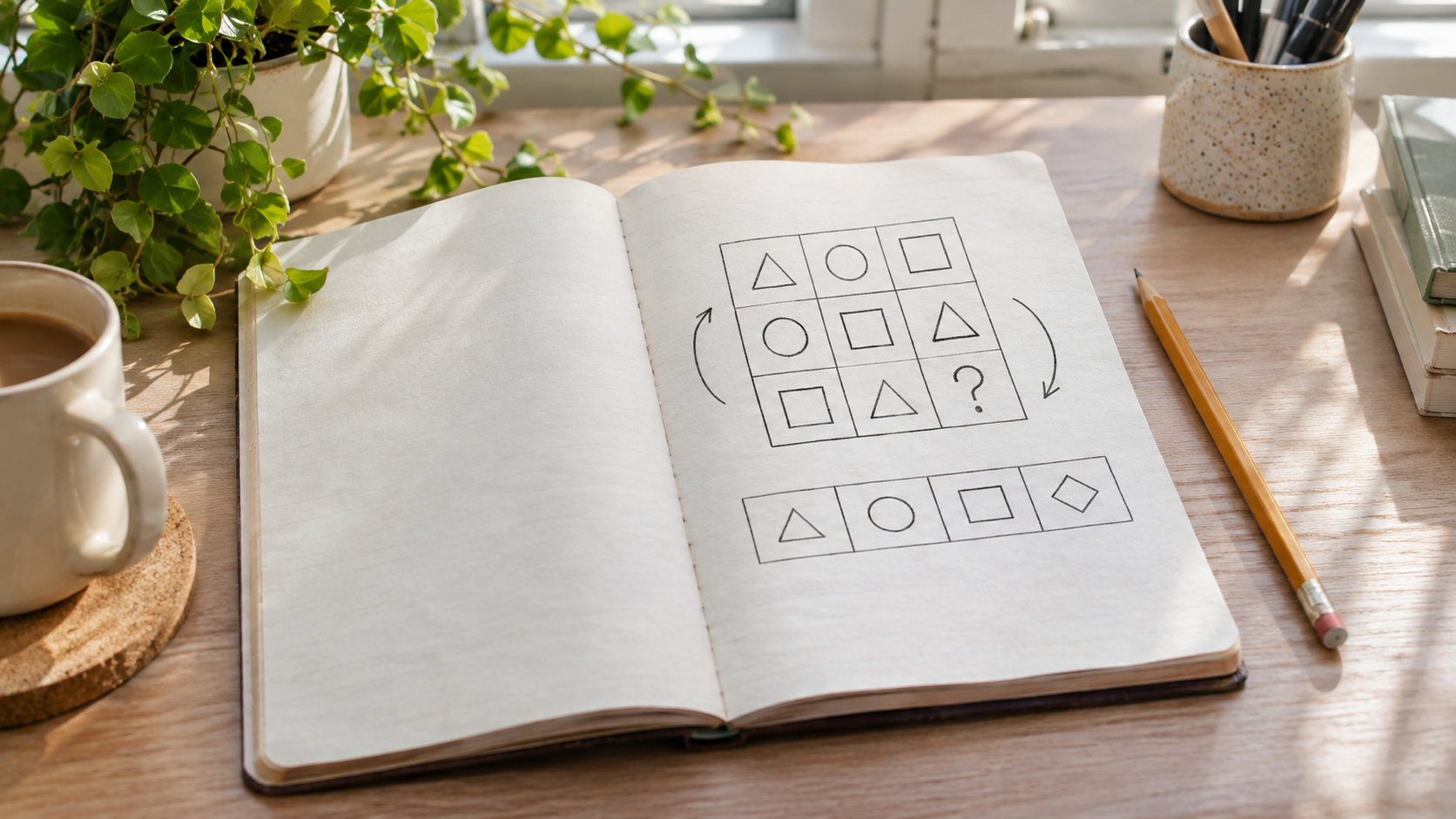
Some employers still ask brainteaser interview questions, but far fewer than a decade ago, and they are usually a small part of a wider interview. What matters is not the trick answer but your visible reasoning: restate the problem, state your assumptions, work a small case, then generalise and sanity-check. Say your steps out loud, and if you get stuck, ask a clarifying question rather than guessing silently.
Where brainteaser questions still show up
Puzzle questions survive in a handful of settings: some quantitative finance, trading and consulting roles, smaller companies where a founder runs the interview, and the occasional graduate scheme that borrows the format. Many other employers have dropped them, and plenty never used them.
They persist because they show how you behave with an unfamiliar problem, not whether you know a trick. A hiring panel learns more from two minutes of you reasoning aloud than from a rehearsed answer to "what is your greatest weakness".
If the job description or a recruiter mentions "puzzles", "problem-solving tests" or "logic questions", prepare the routine below rather than a list of answers. And ask the recruiter what the interview will involve: no one outside a company can tell you its current format, and a direct question is normal.
What a puzzle question is really checking
Four things, in roughly this order:
- Structured thinking. Do you break an unfamiliar problem into steps, or freeze and guess?
- Assumption handling. Do you notice what you are taking for granted, and say it before it matters?
- Communication under pressure. Can you narrate while thinking, and stay calm when you are corrected?
- Coachability. How do you respond when the interviewer says, "what if the coins can't be flipped?"
None of these requires a correct answer. A candidate who reasons cleanly to a wrong number often scores better than one who recites a right number with no working.
The four-step routine to say out loud
- Restate and clarify. Repeat the problem in your own words, then ask one question about constraints. Script: "So I have two eggs, 100 floors, and I want the highest safe floor with the fewest drops in the worst case — can the eggs break, and must the answer be exact?"
- Try the smallest case. Work a tiny version by hand and say what you see. Script: "With two floors and one egg, I'd start at floor one, so the worst case is two drops."
- Generalise and name the pattern. State the rule you think holds, why, and check it on the next size up. Script: "The pattern seems to be that each drop should leave one fewer floor to test than the last, and here's why that balances the worst case."
- Sanity-check and state the answer. Test an edge case, then give the answer in one sentence with your confidence. Script: "At the top end that still fits, so 14 drops covers 100 floors — I'm confident in the arithmetic, less so that I've minimised it."
This is the same discipline as answering ambiguity interview questions: name what you don't know, then proceed. If you tend to rush the first sentence, the habit of pausing before you answer buys you the seconds you need.
Worked example: the two-egg problem
The scenario. You have 100 floors and two identical eggs. Find the highest floor from which an egg can be dropped without breaking, using the fewest drops in the worst case. An egg that survives can be reused; one that breaks cannot.
The naive approach. Drop from floor 10, then 20, then 30. If the first egg breaks at floor 20, you test floors 11 to 19 one at a time with the second egg. Worst case: 10 drops to find the breaking interval, plus 9 more inside it, so 19.
The fix. Shrink the gap by one each time, because each drop you have already spent is one drop you no longer need to spend inside the interval. Drop from floor 14, then 27 (14 + 13), then 39 (14 + 13 + 12), and so on.
The arithmetic. With 14 drops you can cover:
14 + 13 + 12 + 11 + 10 + 9 + 8 + 7 + 6 + 5 + 4 + 3 + 2 + 1 = 105 floors105 is at least 100, so 14 drops is enough. With 13 drops the same sum gives 91 floors, which is short of 100. So the answer is 14 drops, starting at floor 14.
The follow-up it invites. "What if you had three eggs?" Say how you would start rather than recall a formula: with three eggs you can afford a coarser first probe, because a break still leaves two eggs to search the interval below. Try a larger first gap, check the worst case, and adjust — the reasoning is the point.
Worked example: the 25 horses puzzle
The scenario. You have 25 horses and a track with five lanes. Each race takes five horses and tells you their finishing order, with no stopwatch. Find the three fastest horses in the fewest races.
Races one to five. Run five heats of five. Rank each group from first to fifth; label the groups A to E by their winner.
Race six. Race the five heat winners. Suppose the order is A1, B1, C1, D1, E1. Now you know A1 is the fastest overall, so it takes one of the three places.
The elimination before race seven. Any horse that lost to two or more horses already proven faster is out:
- Groups D and E are gone entirely: their winners already lost to A1, B1 and C1.
- In group C, only C1 can still place: C2 and below lost to C1, who lost to A1 and B1.
- In group B, only B1 and B2 can place: B3 lost to B1 and B2.
- In group A, A1, A2 and A3 remain: A4 lost to three horses.
Race seven. The candidates for the two remaining places are A2, A3, B1, B2 and C1 — exactly five horses, so one race settles it. The top two in that race join A1.
How to narrate it. Walk through the eliminations aloud, naming which horse lost to whom. The interviewer can then follow your logic rather than your conclusion, which is what the question is for.
Worked example: a logic puzzle with a twist
The scenario. Two doors: one leads to safety, one does not. Two guards: one always lies, one always tells the truth. You don't know which is which. You get one question to one guard.
The answer. Ask either guard: "Which door would the other guard say leads to safety?" Then take the opposite door.
Why the double negative works. If you ask the truth-teller, he reports the liar's answer, which is the wrong door. If you ask the liar, he lies about the truth-teller's answer, which is also the wrong door. Either way the answer points at the unsafe door, so you invert it.
The trap. Reciting the answer without explaining the cancellation. The interviewer is checking whether you can show why both branches land in the same place — so say both branches, even briefly.
The three-guard follow-up. "What if there were three guards?" Start rather than panic: state what you know ("one question can't separate three unknowns directly"), ask whether the rules are the same for each guard, and propose testing a smaller version first. The follow-up is a reasoning exercise, not a memory test.
When the answer will not come
- Say what you know. "I can rule out X because..." keeps the reasoning visible even without a final number.
- Ask for a hint deliberately. "Can I check whether repetition is allowed?" is a reasoning move, not a failure — it narrows the space.
- Don't bluff. A confident wrong answer with no working reads worse than an honest "I'd try this next".
- Recover after a correction. Acknowledge it, restate the new constraint, and continue from step two.
A short recovery script: "I'm not going to guess. Here's what I've established so far, here's the constraint I'm unsure about, and here's the next thing I'd test — could you confirm whether that constraint holds?"
The one rule: rehearse the routine, not the answers
Memorised puzzle answers collapse the moment the interviewer changes a constraint; the routine survives. Practise three puzzles aloud with a timer, record yourself, and check that each of the four steps is audible. If you use an AI tool to practise, treat its suggested reasoning as a draft that can be wrong, check it yourself, and answer in your own words. The same rehearsal habit fixes the slips in our list of common interview mistakes.
Your next step before the interview
Pick one puzzle you have never seen, set a five-minute timer, and run the four steps aloud to a recording. Listen back for the moment you went quiet — that is where the interviewer would have lost your reasoning. Fix that one moment, then repeat with a second puzzle. Two rehearsals are worth more than twenty memorised answers.
Frequently asked questions
Do companies still ask Google-style brainteaser questions?
Some do, but far fewer than a decade ago, and usually in quantitative finance, trading, consulting or small founder-led firms rather than across the board. Ask the recruiter what the interview will involve. If puzzles are mentioned, prepare the reasoning routine rather than a list of classic answers.
What if I get the wrong answer to a puzzle question?
You can still leave a strong impression if your working was visible. Say which parts you are confident about, name the step where you think the error is, and offer the next test you would run. Interviewers often care more about how you handle being wrong than about the final number.
How long should I spend on a puzzle before asking for a hint?
Give it a minute or two of visible reasoning first, narrating each step. Then ask a specific question about a constraint rather than for the solution: "is repetition allowed?" or "must the answer be exact?" A targeted question shows you have narrowed the problem, which reads better than a long silence.
Are puzzle questions used for non-technical roles too?
Occasionally, mainly in consulting and general-management graduate schemes, and usually as a small part of a broader interview. For most non-technical roles you are more likely to face scenario or behavioural questions. If puzzles are not mentioned in the invitation, spend your preparation time elsewhere.
Should I memorise classic puzzle answers before an interview?
No. A memorised answer falls apart as soon as a constraint changes, and interviewers often change one on purpose. Learn the four-step routine instead: restate, try the smallest case, generalise, sanity-check. That habit transfers to puzzles you have never seen, which is what the question is designed to test.
Practising puzzle answers aloud? See how AI Interview assistant works.